Debate: Democracy is the Best Form of Government (7 Winning Points)
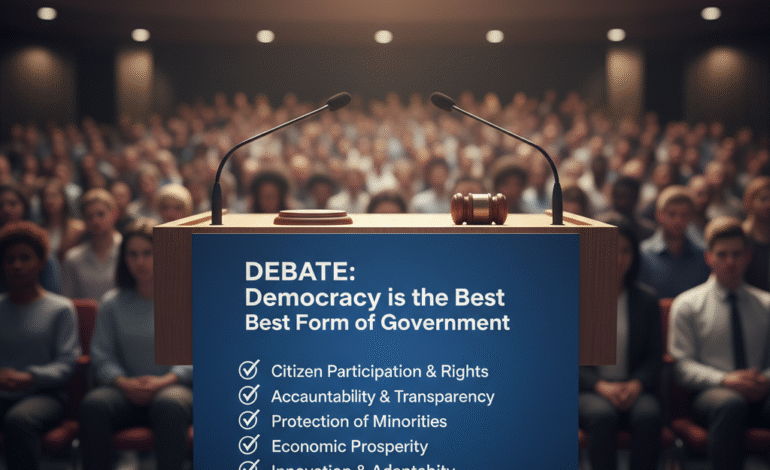
Good day, students!
Looking for the winning points for your next debate? You’ve come to the right place.
Today, we’re tackling a big one. We are supporting the motion that “Democracy is the best form of government.” This debate on democracy is the best form of government is a classic, and I’m here to give you the solid arguments to win.
First, what is democracy? Simply put, it’s a ‘government of the people, by the people, and for the people.’ It’s the system where we, the citizens, have the ultimate power.
Disclaimer: Now, remember, for any school debate, we argue one side. This article provides powerful points to support this motion. It’s for educational purposes and doesn’t mean the opposing side has no points. But our job today is to win this argument.
Let’s get into the script.

Winning Debate Points on Why Democracy is the Best Form of Government
(Here is the speech template you can adapt. Deliver it with confidence!)
“Good day, Mr. Chairman, Panel of Judges, accurate Time-Keeper, co-debaters, and all my fellow students.
I am here today to stand firmly in support of the motion that democracy is indeed the best form of government. This debate on democracy is the best form of government is not just academic; it’s about our lives, our freedom, and our future. And I will prove to you with these 7 points why no other system compares.”
1. It Gives Power to the People (Citizen Participation)
My first and most important point is that democracy is built on citizen participation.
In a democracy, the power is not in the hands of one king, one general, or one small group. It is in our hands—the hands of the people. We are the ones who choose our leaders. We vote them in, and guess what? We can also vote them out.
Think about it. If a leader is not performing, if they are ‘chopping’ money and not building roads or schools, we don’t have to beg or fight. We wait for the next election and remove them with our votes. This right to choose is the greatest power.”
2. Democracy Protects Human Rights
“Another key point is the protection of our basic human rights.
True democracy cannot exist without respecting the rights of every single person, whether they are rich or poor, or from any tribe. What rights am I talking about? The right to life. The right to be treated fairly. The right not to be arrested without cause.
In other systems, the government can just decide to lock you up. In a democracy, you have rights that even the government must respect. These rights are written down in a constitution, and they protect us.”
3. It Guarantees Freedom of Speech
“Now, let’s talk about your voice. My third point is freedom of speech.
In a democracy, you are free to speak your mind. You can criticize the government. You can protest peacefully. You can (as we are doing right now) even debate!
This freedom is not a small thing. It is how we expose corruption. It is how we demand change. In many other systems, saying the wrong thing can land you in prison. In a democracy, it’s called ‘opinion’.”
4. It Ensures Accountability and Transparency
“My fourth point is about accountability. Because leaders know they will have to face us for re-election, they are forced to be accountable for their actions.
But here’s the thing: it’s not just about elections. Democracy creates systems like a free press, independent judges, and opposition parties. These systems help us ask questions. ‘Where did the money go?’ ‘Why is this project not finished?’
This is transparency. The government is supposed to work in the open, not in secret. This forces them to (at least try to) serve the people.”
5. Democracy Follows the Rule of Law
“This leads me to the rule of law. What does this mean? It means nobody is above the law.
Not the president, not the richest man, not the police. The law is the law, and it applies to everyone, equally. This is the opposite of a system where one person’s word is law.
The rule of law protects us from chaos and tyranny. It creates checks and balances so that no one part of the government—not the president, not the parliament, not the courts—can become too powerful.”
6. It Allows for a Peaceful Transition of Power
“Imagine this: a leader fails, or their time in office is up. What happens next?
In many other systems, the answer is violence, a coup, or even a civil war. But in a democracy, the answer is an election. This is what we call a peaceful transition of power.
We change governments with ballots, not bullets. This stability is why democratic countries are often more peaceful and developed. We can disagree strongly, but we agree to settle our differences at the polling booth.”
7. It Leads to Better Decisions and Development
“Finally, all these points add up to one thing: better decisions and more stable economic development.
When leaders have to listen to the people (citizen participation), respect their rights (human rights), and answer for their actions (accountability), they are forced to make better policies.
They can’t just build a new palace for themselves; they have to build the schools, hospitals, and roads that we demand. It’s not a coincidence that the most developed and stable nations in the world are democracies. It’s the system working.”
Frequently Asked Questions (FAQs)
What’s the strongest argument for the other side?
Opposers often argue that democracy is slow, messy, and that sometimes, a strong, ‘benevolent’ leader (like in an autocracy) can make decisions faster to grow the economy. Your job is to argue that this ‘speed’ often comes at the cost of human rights, freedom, and long-term stability.
How do I conclude this debate?
You should summarize your main points. Remind the judges that power in the hands of the people, human rights, and the rule of law are more important than anything else. End with a strong, confident line like, “A system that trusts its people is always better than one that fears them. Thank you.”
Is any country a ‘perfect’ democracy?
That’s a good question. No system is perfect. Even in big democracies, there are problems with corruption or making sure everyone’s voice is heard. But the ideal of democracy—the goal—is still the best one to aim for. It’s the only system that allows us to fix its own problems peacefully.
Conclusion / Summary
So there you have it!
To win this debate on democracy is the best form of government, you just need to be confident. Remind everyone that democracy gives us power, protects our rights, gives us freedom of speech, and holds our leaders accountable.
Disclaimer: Remember, this is an educational debate. The goal is to practice our arguments and critical thinking. In the real world, every system has its challenges, but today, your job is to show why democracy’s strengths are the most important.
What do you think? Do you have another winning point? Drop your opinions in the comments section below!
Also, feel free to share this post with your coursemates or those in your debate team!