Debate: A Woman’s Place is Not in the Kitchen (7 Winning Points)
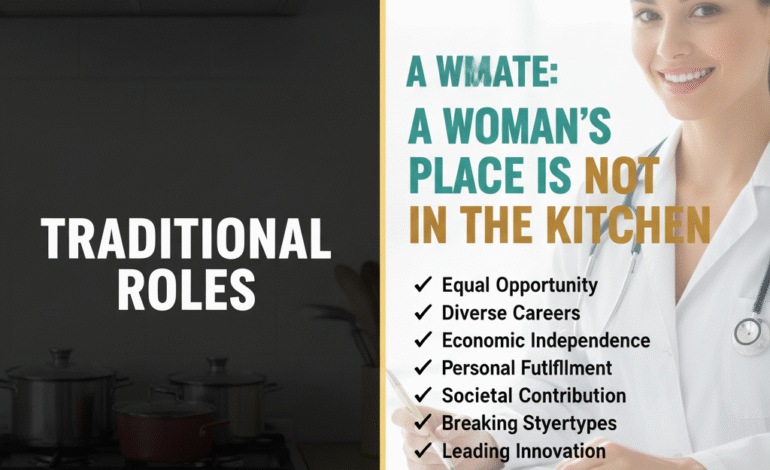
Debate: A Woman’s Place is Not in the Kitchen (7 Winning Points)
Good day, debaters! Are you ready to win your next debate competition? If you are arguing for the motion that “a woman’s place is not in the kitchen,” you have come to the perfect place. I’ve prepared the winning script for you.
When we talk about this topic, we are challenging the old-fashioned and harmful idea that a woman’s only role is to cook, clean, and take care of the home.
We are not saying cooking or housework is bad. We are saying a woman’s potential, her brain, and her dreams are far, far bigger than just one room in the house. Finding strong a woman’s place is not in the kitchen debate points is the key to proving this, and that’s exactly what I’m giving you today.
Disclaimer: This article provides powerful arguments for one side of an educational debate. The goal is to help you argue your position effectively. It does not mean that domestic work or being a homemaker is unimportant.
Winning Debate Points: Why a Woman’s Place is Not Just in the Kitchen
Here is the script. You can adapt it, but these are the core arguments you need.
1. The Kitchen is a Box; A Woman’s Potential is Limitless
Good day, Mr. Chairman, panel of judges, accurate timekeeper, co-debaters, and my fellow students.
My first and most important point is simple: forcing a woman to stay only in the kitchen is a massive waste of human potential.
Think about it. When you give a girl a quality education, you are not just teaching her to read. You are training a future doctor, a future engineer, a future programmer, or even a future president of Nigeria. Our society needs their brains, their potential and skills in our hospitals, in our banks, and in our government offices.
To say her only place is the kitchen is to lock away half of our nation’s talent. That’s a loss for everyone.
2. Women are Critical Economic Contributors, Not Just Cooks
Now, let’s talk about the money. The economic contribution of women is a serious matter.
In Nigeria today, women are entrepreneurs. They are market women. They are bank CEOs. They are doctors. They are earning income that feeds their families, pays school fees, and builds our nation’s economy.
If a woman is using her skills to run a business or practice law, she is contributing directly to our GDP. This is a fact. Keeping her chained to the kitchen removes her from the official workforce and makes the entire country poorer. We need her in the office, the market, and the boardroom.
3. We Must Break Harmful Stereotypes for Progress
My opponents will stand here and talk about ‘tradition’ or ‘culture.’ But I ask you, what tradition? The idea that women are only good for cooking is a harmful stereotype, not a healthy tradition.
Breaking stereotypes is how societies grow and become better. We once had traditions that twins should be killed, but we broke that stereotype. In this modern society, we must see people for their ability, not their gender.
These old ideas don’t just hold women back. They also put unfair pressure on men to be the only provider. True progress means achieving gender equality for the good of all.
4. The World Needs Women in Leadership
Look around the world and even here in Nigeria. When women are involved in leadership, communities change for the better.
We need women in leadership positions. Women often bring different and needed perspectives. They focus on health, education, and building communities. Think of great women like Dr. Ngozi Okonjo-Iweala. Was her place in the kitchen? No! Her place was at the World Bank and now leading the World Trade Organization, making decisions that affect millions.
This is the kind of female empowerment we should be encouraging, not fighting against.
5. Domestic Responsibilities Belong to Everyone
Here’s the truth my opponents might be afraid to say: cooking and cleaning are not ‘women’s jobs.’ They are life skills.
These domestic responsibilities should be shared by everyone living in the home. A boy should learn to cook. A man should know how to wash his own clothes. A girl can learn to fix a lightbulb.
In the 21st century, a family is a team. We cannot put all the housework on one person while the other person chases their dreams. That is not partnership; that is using someone.
6. It is a Matter of Basic Human Rights and Choice
Ultimately, this entire debate is about choice. This is a matter of women’s rights.
A woman should have the right to choose her own path. If her passion is to be a world-class chef, fantastic! The kitchen is her profession. But if her passion is to be an astronaut, a lawyer, or a soldier, who are we to tell her “No, go back and cook”?
Saying her place is only in the kitchen denies her the basic human right to pursue her own destiny.
7. The Kitchen is a Room, Not a Prison
To conclude my points, let me be very clear. We are not insulting the kitchen. The kitchen is a very important room for everyone.
But it is a room, not a prison.
It is a place for nourishment, not a life sentence. A woman’s place is wherever her talents, her dreams, and her hard work take her.
Thank you.
Frequently Asked Questions (FAQs)
What’s the strongest argument from the other side? Your opponents (the ‘opposition’) will likely argue that their view is based on culture and religion. They might say women are “naturally” better at nurturing and that having a dedicated homemaker creates a stable family. Your job is to show that “nurturing” doesn’t just mean cooking, and that a stable family is one where both parents are supported.
How do I conclude this debate speech? End with a powerful summary. Don’t just list your points again. End with a strong emotional statement, like the “room, not a prison” point. Remind the judges that a nation that limits its women, limits its own future. Always end by confidently thanking the judges, timekeeper, and audience.
Does this mean women should never cook? Absolutely not! Be careful, this is a common trap. You must make it clear: cooking is a vital life skill for everyone—men and women. This debate isn’t about stopping women from cooking. It’s about stopping society from forcing them to only cook and do nothing else with their lives.
Conclusion / Summary
As you can see, the arguments against this outdated idea are strong. The best a woman’s place is not in the kitchen debate points focus on her wasted potential, her economic value, the need for gender equality, and the simple fact that housework is a shared job.
Final Disclaimer: Remember, this article is for educational debate purposes only. We respect all individuals and the choices they make, whether they are homemakers, professionals, or both. The goal of a debate is to explore all sides of an issue.
What do you think? Did I miss any strong points? Drop your opinions in the comments section below! Also, feel free to share this post with your coursemates or those in your team!