5 Note-Taking Strategies That Will Save You During Exam Week
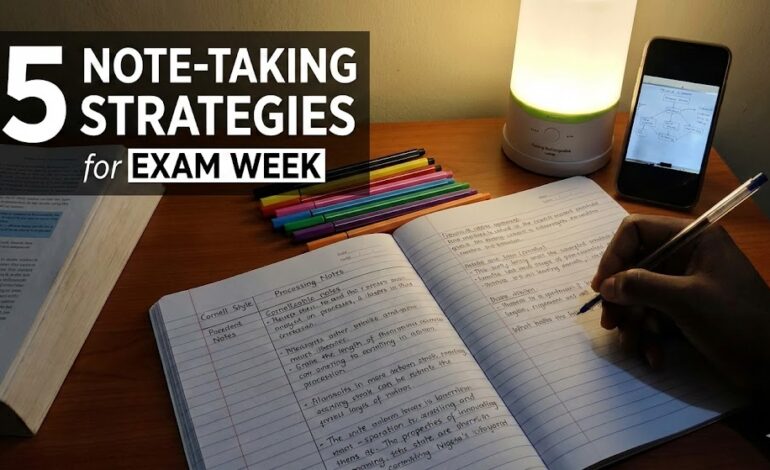
It’s 11 PM. The generator has just been turned off, your rechargeable lamp is fading, and you have a Chemistry exam at 8 AM tomorrow. You open your notebook, hoping to revise, but all you see is a wall of blue ink. No structure, no highlighted points, just pages and pages of writing that looks like spiritual handwriting.
Sound familiar?
We’ve all been there. You spent the whole term copying exactly what the lecturer or teacher wrote on the board, thinking you were being a “serious student.” But now that the pressure is on, those notes are useless. You can’t find the main points, and panic starts to set in.
Here is the bitter truth: Writing everything down isn’t studying; it’s dictation.
To actually pass WAEC, JAMB, or that scary departmental course, you need notes that work for you, not against you. You need systems that make revision fast.
Based on years of seeing students struggle and succeed, here are 5 note-taking strategies that will save you during exam week.

1. The “Divide and Conquer” (Cornell Method)
I used to think this method was too fancy for Nigerian schools, but trust me, it’s a lifesaver. It stops you from just writing blindly.
Most students write from the left margin all the way to the right. The problem? When you look at the page later, there’s no white space to rest your eyes. It’s overwhelming.
How to do it:
-
Draw a vertical line down your page, about one-third of the way from the left.
-
Right Side (The Notes): Write your normal class notes here. But don’t write sentences. Use bullet points.
-
Left Side (The Cues): After class (or while studying), write key questions or keywords here. For example, if the right side explains “Photosynthesis,” the left side should ask, “What are the 3 stages of photosynthesis?”
-
The Bottom Summary: Leave a small space at the bottom to write a two-sentence summary of the whole page.
Why does this work? During exam week, you don’t read the notes. You cover the right side and try to answer the questions on the left. It forces your brain to work.
2. The Spider Web (Mind Mapping)
If you are studying subjects like History, Government, or Biology, linear notes can get boring fast. You might find yourself dozing off.
Mind mapping is for the visual learners. It helps you see how topics connect, which is exactly what examiners look for in essay questions.
The Strategy: Start with the main topic in the center of the page (e.g., “The Nigerian Civil War”). Draw branches out for sub-topics like “Causes,” “Key Actors,” “Timeline,” and “Aftermath.”
Don’t use full sentences. Use images, symbols, or single words. It looks messy to others, but to your brain, it’s a map.
Pro Tip: I’ve seen students use different colored pens for this. It sounds childish, but color helps memory recall. When you’re in the exam hall, you might not remember the text, but you’ll remember that “Ojukwu” was written in red ink.
3. The “Empty Sheet” Challenge (Blurting)
This is technically a revision method, but it changes how you take notes. It is arguably the most aggressive way to check if you are ready for JAMB or Post-UTME.
A lot of students suffer from the “Illusion of Competence.” You read your textbook, nod your head, and think, “Yes, I know this.” But the moment you close the book, the information vanishes.
How to do it:
-
Read a section of your textbook or notebook.
-
Close the book. hide it far away.
-
Take a blank sheet of paper.
-
Write down everything you can remember. Everything.
-
Open the book and check what you missed.
The things you missed? Write them in a different color. These are your actual notes for exam week. Stop reviewing what you already know; focus on the gaps.
4. The 60-Second Summary
Lecturers love to talk. Sometimes they speak for two hours, but the actual point of the lecture could be summarized in five minutes.
The mistake most students make is trying to transcribe the lecture word-for-word. You are not a court stenographer.
Instead, try this: Listen for 15 minutes, then write a summary. Listen for another 15, write another summary. By the end of the class, instead of 10 pages of fluff, you have 1 page of pure gold.
This is crucial for university students. Lecturers often drop hints like, “This is important,” or “You might see this again.” If you’re too busy writing nonsense, you’ll miss those hints.
5. Digital Backups (The Hybrid Approach)
Let’s be real—we are in the digital age. While I always recommend writing by hand because it helps memory retention, your phone is a powerful tool if you use it right.
Sometimes, the teacher writes a complex diagram on the board. Don’t waste 20 minutes trying to draw it perfectly while missing the explanation.
-
Snap a clear picture of the board.
-
Later, when you are rewriting your notes, look at the picture and draw it at your own pace.
-
Use voice notes. If you’re tired of reading, record yourself reading your summary notes.
Listen to these recordings while you’re doing chores, sitting in a bus, or walking to class. It’s a great way to “study” when you don’t have the energy to open a book.
According to a report by the [University of Lagos (or insert relevant reputable source regarding study habits)], active engagement with material—like speaking it aloud—increases retention rates significantly compared to passive reading.
Conclusion: Don’t Just Read, Engage
The difference between the student who sweats in the exam hall and the one who writes calmly isn’t usually intelligence. It’s strategy.
You don’t need to use all 5 note-taking strategies that will save you during exam week. Pick one or two that fit your style. Maybe you’re a Mind Map person, or maybe the Cornell method fits your organized brain.
The goal is to stop cramming and start understanding.
Which of these methods have you tried before? Or do you have a special “formation” for studying that we missed? Let me know in the comments below!