Cramming vs. Spaced Repetition: The Science of Retaining Information for Nigerian Students
Cramming vs. Spaced Repetition: The Science of Retaining Information for Nigerian Students
It’s 2 AM. Your eyes are heavy, your back hurts, and you have a cryptic PDF from your lecturer or a massive chemistry textbook open in front of you. You are trying to force an entire semester’s worth of definitions into your brain before the sun comes up.
Does this sound familiar?
If you are a Nigerian student, this is almost a rite of passage. We call it “fire brigade approach” or “crashing.” But here is the bitter truth: relying on last-minute studying is playing Russian Roulette with your GPA.
Today, we need to settle the debate of Cramming vs. Spaced Repetition: The Science of Retaining Information. If you want to stop scraping by with “Let my people go” grades and actually crush your WAEC or JAMB, you need to change how your brain processes data.

The “La Cram, La Pour” Trap
We have all been there. You memorize the definition of “Osmosis” word-for-word just minutes before the invigilator walks in. You write it down, pass the test, and feel like a genius.
But two days later? You can’t remember a thing.
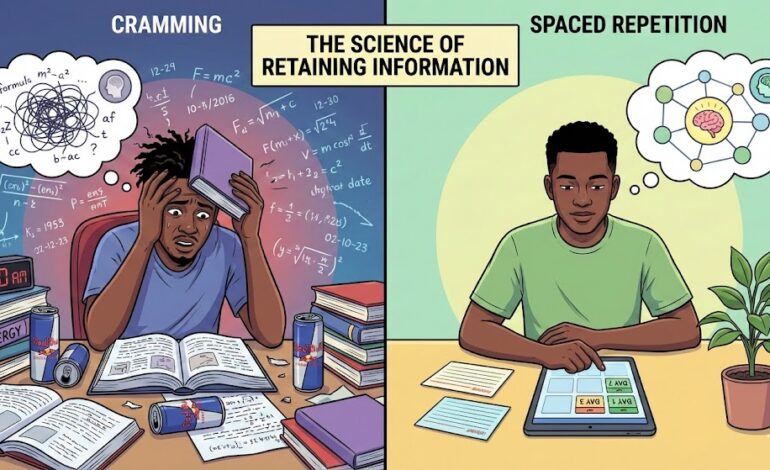
This is the problem with cramming. It creates an illusion of competence. You recognize the information because it’s sitting in your short-term memory, but you haven’t actually learned it. It’s like pouring water into a basket; it stays for a second, then drains out.
When you cram, you are stressing your brain. You aren’t building neural pathways; you’re just stacking boxes that are going to fall over the moment the exam pressure hits. That’s why you might blank out in the exam hall even though you “read” all night.
The Science: Why You Forget (The Forgetting Curve)
To understand why cramming fails, you have to understand how your brain deletes things.
There’s a concept called the “Forgetting Curve.” Research shows that within 24 hours of learning something new, you forget about 50% to 80% of it unless you review it. By the end of the week, you might remember only 10% or less.
This is why you can attend all your classes, copy all the notes, and still fail. Your brain assumes that because you didn’t look at the information again, it wasn’t important. So, it hits the delete button to save space.
This is where the battle of Cramming vs. Spaced Repetition: The Science of Retaining Information is won. One fights your brain’s natural tendency to forget; the other ignores it.
Enter Spaced Repetition
Imagine you want to build muscle. What works better?
-
Going to the gym for 10 hours straight on one Saturday.
-
Going to the gym for 45 minutes, four times a week.
Obviously, it’s the second one. Your brain works the exact same way.
Spaced Repetition is a study technique where you review material at increasing intervals. Instead of reading a topic for 5 hours once, you read it for 30 minutes today, then 10 minutes two days later, then 5 minutes a week later.
Each time you review the material just as you are about to forget it, your brain says, “Oh, he still needs this info? Okay, let me lock it into long-term memory.”
According to psychological research from sources like Verywell Mind, this method drastically increases retention rates. It stops the forgetting curve in its tracks.
How to Use the “Shoebox Method” (Leitner System)
You don’t need a fancy laptop or expensive software to do this. You can start today with some paper and three empty boxes (or envelopes).
Here is a simple breakdown of how to apply this for your next exam:
1. Create Flashcards
Write a question on one side of a piece of paper (e.g., “What is the capital of Zamfara?”) and the answer on the back. Do this for your definitions, formulas, or dates.
2. The Three Boxes
Label your boxes (or sections of your table):
-
Box 1: Every Day
-
Box 2: Every 3 Days
-
Box 3: Once a Week
3. The Process
-
Start: Put all your cards in Box 1.
-
Test Yourself: Pick a card from Box 1. If you get the answer right, move it to Box 2. If you get it wrong, keep it in Box 1.
-
Review Box 2: Three days later, test yourself on the cards in Box 2. If you get it right, upgrade it to Box 3. If you get it wrong? It goes all the way back to Box 1.
-
Review Box 3: Once a week, check these cards. If you get it right, it’s mastered. If you slip up, send it back to Box 1.
This forces you to focus your energy on the things you don’t know, rather than wasting time reading the things you already know.
Digital Tools for the Tech-Savvy
If writing on paper feels like too much work, or you are prepping for a CBT exam like JAMB, you can use apps.
-
Anki: This is the king of spaced repetition. It uses an algorithm to show you flashcards exactly when you are about to forget them.
-
Quizlet: Very popular and has a great interface, though the spaced repetition features are often paid now.
Using these tools can give you an edge, especially for objective questions. You can read more about effective study habits on Khan Academy’s test prep strategies, which often highlight active recall.
Summary: Cramming vs. Spaced Repetition
Let’s break down the differences clearly.
| Feature | Cramming | Spaced Repetition |
| Effort Level | High intensity, short time. | Low intensity, consistent time. |
| Retention | High for 12 hours, then crashes. | High for months or years. |
| Stress Level | Extreme panic. | Manageable and calm. |
| Best For | Forgetting everything after the exam. | actually learning the course. |
Conclusion
Look, I know the struggle. The electricity might be bad, the hostel is noisy, and sometimes you just don’t feel like reading. But the difference between Cramming vs. Spaced Repetition: The Science of Retaining Information is the difference between hoping for a pass and guaranteeing one.
Stop punishing yourself with all-nighters. Start small, space it out, and watch your grades climb.
Which side are you on? Are you a loyal member of the “Fire Brigade” cramming squad, or have you tried spacing out your reading? Let me know in the comments below!