Last Minute Study Tips for Exams That Actually Works (Even If You Didn’t Read)

Last Minute Study Tips for Exams That Actually Works (Even If You Didn’t Read)
The exam timetable is out. Actually, it’s worse than that—the exam is tomorrow morning.
Your notes are piling up on the table, your textbook looks like it’s written in Greek, and you’re starting to feel that familiar heat in your chest. We’ve all been there. Maybe you procrastinated, maybe life happened, or maybe you just underestimated the syllabus.
Panic won’t help you now.
What you need is a strategy. You don’t have time to read everything, so you have to be smart about what you read. You need Last Minute Study Tips for Exams That Actually Works to save your grades.
Let’s be honest: you probably won’t score an A parallel if you are starting from scratch tonight. But these steps can move you from an “F” to a “C,” or a “C” to a “B.”
Here is how to survive the night and crush that paper.

1. Stop Reading; Start Filtering (The 80/20 Rule)
A lot of students make a fatal mistake when they are pressed for time. They open the textbook to Chapter 1 and try to read line-by-line.
Please, don’t do that.
You do not have the luxury of time to read the history of the topic or the long introduction. You need to apply the 80/20 rule. In almost every Nigerian exam—whether it’s WAEC, NECO, or a university semester exam—80% of the marks come from 20% of the topics.
How to filter quickly:
-
Look at the course outline or syllabus. What topics did the lecturer or teacher shout about in class?
-
Check your notebook. Which topics have the most notes?
-
Focus strictly on definitions, key formulas, and bolded terms.
Forget the fluff. If a topic looks too complex and you have zero clue about it, skip it. Yes, skip it. It’s better to master three easy topics perfectly than to confuse yourself with five hard ones.
2. The “Past Question” Hack is Non-Negotiable
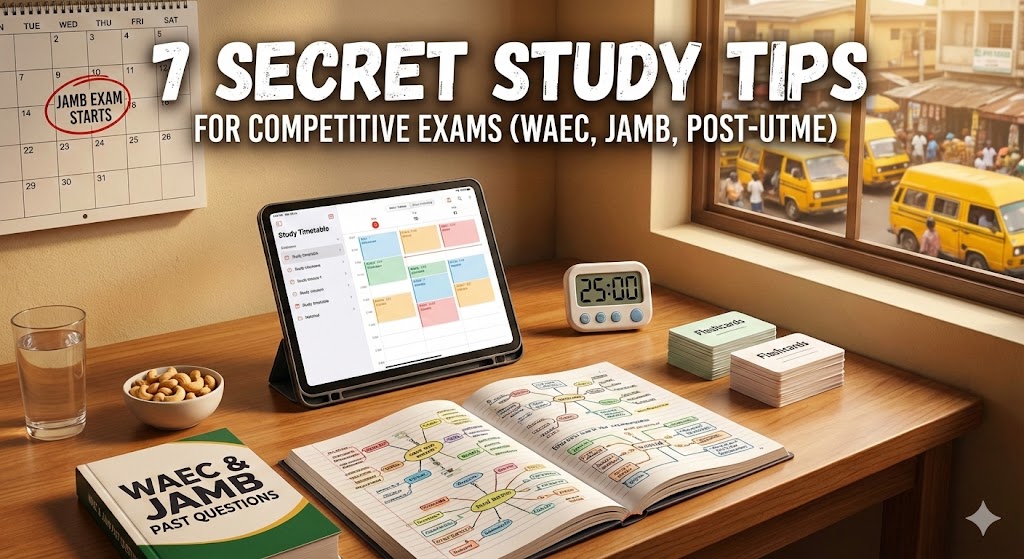
If you are preparing for JAMB, Post-UTME, or WAEC and you are not using Past Questions, you are playing a dangerous game.
This is the holy grail of last-minute studying.
Examiners are humans. They get tired. Often, they recycle questions from previous years or tweak them slightly. Even in universities (like UNILAG, UI, or OAU), lecturers often repeat questions from the last 3-5 years.
Here is the strategy: Don’t just answer the questions in your head. Treat the Past Question booklet like a textbook.
-
Read a question.
-
Look at the answer.
-
Understand why that is the answer.
If you see a specific topic appearing every single year (like “Organic Chemistry” in Chemistry or “Indices” in Maths), that is your signal. Go and study that topic immediately.
For standardized tests, organizations like JAMB usually stick to a specific syllabus pattern, so mastering past trends is often enough to get you a pass mark.
3. Use the “Blurt” Method (Stop Staring at Your Notes)
Here is a trap many students fall into: passive reading.
You stare at your notebook, your eyes follow the words, and you tell yourself, “Okay, I know this.” But the moment you close the book, your brain goes blank. You recognize the words, but you haven’t actually learned them.
Try the Blurt Method instead:
-
Read a section or a paragraph.
-
Close the book.
-
Grab a rough sheet of paper.
-
Scribble down everything you can remember from that section without looking.
-
Open the book and check what you missed.
This is active recall. It forces your brain to work. It’s painful and tiring, but it sticks. It is much faster than highlighting sentences you will never look at again.
4. Don’t Do “TDB” (Till Day Break)—Seriously
I know what you’re thinking. “I have 10 hours until the exam, I will use all 10 hours.”
This is a lie.
The culture of “TDB” (reading Till Day Break) is one of the biggest reasons students blank out in the exam hall. Your brain needs sleep to consolidate memory. If you stay awake all night on Red Bull or coffee, you might read a lot, but you will remember very little.
Plus, you’ll be groggy. You might misread questions or make silly calculation errors.
Do this instead: Study hard until maybe 2:00 AM. Then sleep. Get at least 4 hours of rest. You will wake up with a clearer head. Research from health institutions and universities like Harvard consistently shows that sleep improves retention, even during stressful periods.
5. Turn Your Phone to “Do Not Disturb” (Or Off)
This sounds obvious, but let’s be real.
You are stressed, so you check WhatsApp to see if your coursemates are also stressed. You go on Twitter (X) to see trends. Before you know it, 45 minutes have passed.
You cannot afford that time tax right now.
If you are using your phone to read PDFs, turn off the data. If you are using hardcopy notes, throw the phone across the room. Tell your friends you are going off the grid.
Every time your phone buzzes, it breaks your focus. It takes about 20 minutes to get that deep focus back. You don’t have 20 minutes to waste.
Summary: You Can Still Salvage This
It is normal to be scared. The pressure to pass WAEC or maintain a good CGPA is heavy. But panicking is energy wasted.
Use these Last Minute Study Tips for Exams That Actually Works to maximize the little time you have left. Focus on the high-yield topics, use past questions as your map, and please, get some sleep.
You might not know everything, but you can know enough to pass. Now, put your phone down and go read. Good luck!