How to Be Smart in School Without Studying (The Honest Answer)

How to Be Smart in School Without Studying (The Honest Answer)
Let’s be real for a second. We all know that one student. They hardly ever open a textbook. You see them playing football, pressing their phone, or hanging out at the buttery while you are sweating in the library. Yet, when the WAEC or semester results come out, they are carrying A’s and B’s while you are struggling to understand how you got a C.
It’s annoying, isn’t it?
You start wondering if they are using “jazz” or if they are just naturally gifted geniuses. But here is the secret: they aren’t magicians. They have just figured out How to Be Smart in School Without Studying (The Honest Answer).
Okay, let me be brutally honest with you. If you think this article will teach you how to stare at the ceiling and magically pass JAMB, you are in the wrong place. That doesn’t happen. But, if you want to know how to cut your reading time in half and still score higher than the guys who sleep in the library (the “jackometers”), then listen up.
Here is how to hack the system.

1. The “Osmosis” Trick: Master the Art of Listening
Most students get this wrong. They see class time as “social hour” or “sleeping time.” They sit at the back, pinging on WhatsApp, planning to “read the topic later.”
That is a trap.
If you have to go home and read a topic from scratch for three hours, you wasted the one hour you spent in class. The smartest students use class time to absorb the heavy lifting.
Here is the strategy:
-
Sit in the “T-Zone”: This is the front row or the middle center. It forces you to stay awake.
-
Ditch the dictation: Don’t try to write down every single word the lecturer says. You aren’t a stenographer. Just write the key points.
-
Listen for the “Tell”: Teachers often give away exam questions without knowing it. When they say, “This is very important,” or they repeat a phrase three times? Put a star next to it. That is your exam question.
By the time you get to the hostel, you aren’t trying to learn the topic. You are just reviewing it. That takes 20 minutes, not 3 hours.
2. The “Teacher” Technique (Teach Your Guys)
There is a psychological concept called the Protégé Effect. Basically, you learn better when you expect to teach someone else.
In a Nigerian university or secondary school setting, this is easy. Find a study group, but don’t just sit there quietly. Volunteer to explain a specific topic to your friends.
If you can explain a complex biology concept in Pidgin or simple English so that your friend understands it, you have mastered it. You won’t need to cram it anymore. It’s stuck in your head.
As The Learning Center at UNC explains, simplifying a concept is the ultimate test of understanding. If you can’t explain it simply, you don’t know it well enough.
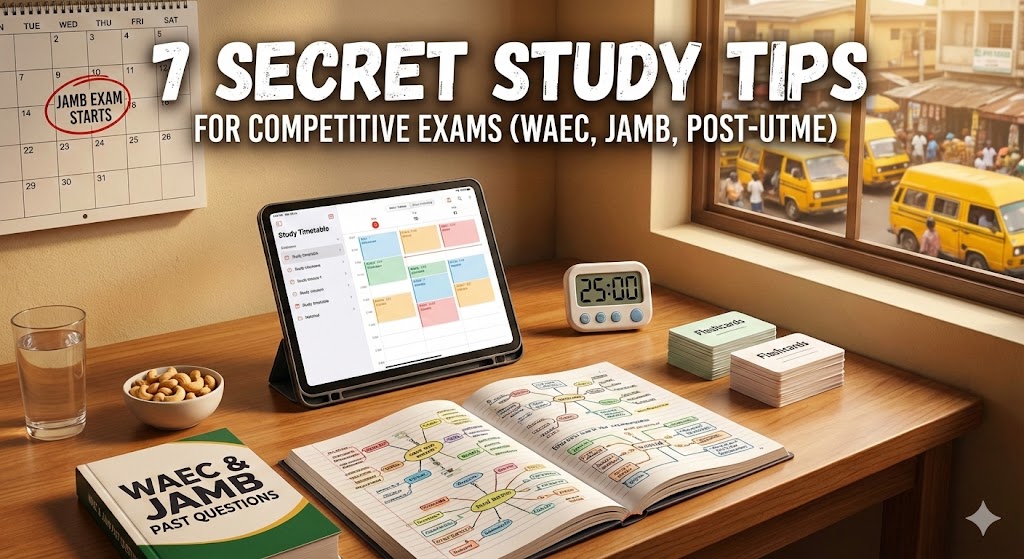
3. Past Questions are the Cheat Code
I cannot stress this enough. Whether you are writing WAEC, NECO, JAMB, or Post-UTME, the examiners are lazy.
They do not invent new questions every year. They recycle old ones.
The student who “studies hard” reads the entire textbook from cover to cover. The student who is “smart” looks at the last 10 years of past questions first. They identify the patterns.
How to do it:
-
Get the past question booklet for your course.
-
Circle the topics that appear every single year.
-
Focus 80% of your energy on those topics.
You are effectively predicting the future. Why read chapter 15 if they haven’t set a question from it since 2004? That’s not being lazy; that’s being efficient.
4. Be Curious, Not Just Studious
Smart students don’t just read to pass; they read to know.
When you are genuinely curious about something, your brain releases dopamine, which helps memory retention. If a lecturer mentions a concept like “AI in Nigeria,” don’t just wait for the note. Google it immediately. Watch a 5-minute YouTube video on it.
Visuals stick longer than text. A video explaining the Nigerian Civil War is easier to remember in a Government exam than five pages of boring text.
According to research cited by Edutopia, engaging with visual aids and drawing out concepts significantly boosts memory compared to just reading text.
5. The Power of Rest (Why “Jackometers” Crash)
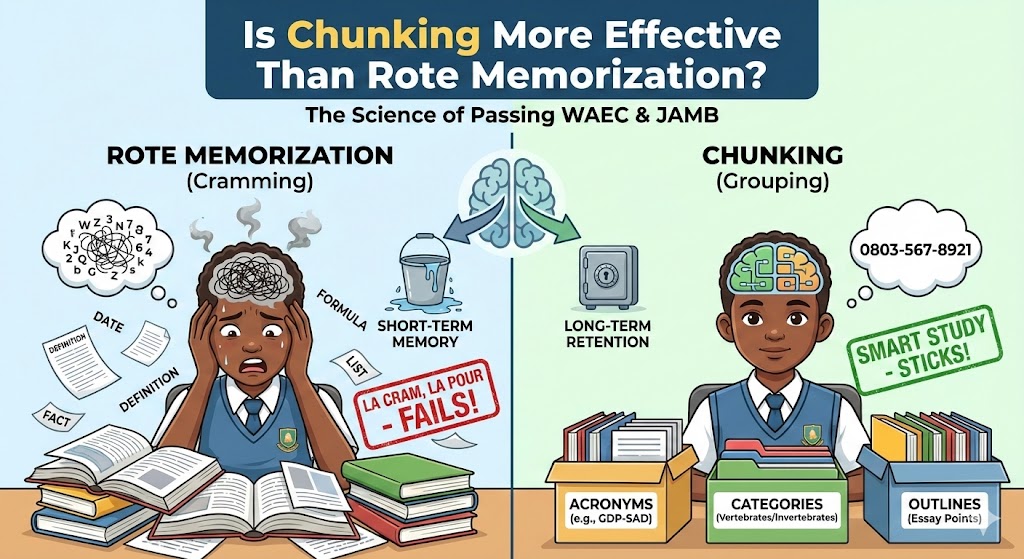
You know the “La cram, la pour” gang? They read for 12 hours straight the night before the exam. They drink coffee, chew kola nut, and refuse to sleep.
Then they get to the exam hall and blank out.
Your brain needs sleep to move information from short-term memory to long-term memory. If you don’t sleep, you are literally deleting the files you just uploaded to your brain.
The “smart” student sleeps for 6–7 hours. They walk into the exam hall fresh. Their brain can make connections that the tired student can’t see.
Conclusion
So, can you pass without doing anything? No.
But How to Be Smart in School Without Studying (The Honest Answer) is about changing how you engage with school. It is about listening so you don’t have to read as much. It is about using past questions so you don’t waste time on irrelevant topics.
It is about working smarter, not harder.
Which of these habits are you going to try this semester? Or do you have a trick that saves you stress? Let me know in the comments below!