


How to Remember What You Read Without Taking Notes (and Actually Retain It)

How to Remember What You Read Without Taking Notes (and Actually Retain It)
You know the feeling. It’s two weeks before your semester exams or WAEC, and you’re staring at a textbook that looks like a brick. You have a pen in your hand, and you’re frantically copying almost every sentence into your notebook. By the time you’ve finished a chapter, your hand hurts, your neck is stiff, and—here is the worst part—you haven’t actually learnt much.
You just became a photocopier machine.
Many students think writing everything down is the only way to study. But let’s be honest, most of those notes just gather dust. What if I told you that you could ditch the pen (mostly) and still crush your exams?
Today, we are going to look at How to Remember What You Read Without Taking Notes (and Actually Retain It). It sounds risky, right? But for many students, this method is actually faster and sticks in the brain longer than mindless copying.
Here is how you can read, understand, and remember without filling up ten different notebooks.

1. Stop “Passive” Reading (The Zombie Mode)
The biggest mistake Nigerian students make isn’t that they aren’t reading enough; it’s that they are reading passively. You know what I mean. You are reading the words, but your mind is thinking about what you’ll eat for dinner or that gist on Twitter.
When you take notes verbatim, you often switch your brain to “autopilot.” You see a word, you write it. That’s not learning.
To retain information without notes, you have to switch to Active Reading. This means your brain has to work. It has to sweat a little bit. You need to constantly ask yourself: “Does this make sense?” and “How does this connect to what I read on the previous page?”
2. Use the “Blurting” Method (Active Recall)
This is a game-changer. If you visit any medical school library, you’ll see students doing this. It’s arguably the most powerful study technique out there.
Here is how it works:
-
Read a section of your textbook (maybe 2-3 pages).
-
Close the book.
-
Say out loud everything you can remember from that section. Explain it to the empty room.
-
Open the book and check what you missed.
If you can’t say it without looking, you don’t know it yet. Writing it down wouldn’t have saved you. By forcing your brain to “retrieve” the information immediately, you are strengthening the neural pathways in your brain.
Pro Tip: Don’t just whisper. Speak up. If you are in a noisy hostel or library, just mouth the words. The act of formulating sentences forces you to understand the logic, not just memorize the words.
3. The Feynman Technique (Teach It to a 5-Year-Old)
Albert Einstein (or maybe it was Richard Feynman, who cares who said it, it works) once said, “If you can’t explain it simply, you don’t understand it well enough.”
Imagine you are trying to explain the concept of Demand and Supply or Osmosis to your younger sibling in JSS1. Could you do it using simple English? Without using big grammar?
When you read a difficult concept, look away from the book and try to simplify it in your head. Use analogies.
-
Example: Instead of just memorizing that “Mitochondria is the powerhouse of the cell,” visualize it as the generator in your compound that gives light to the whole house.
If you can visualize it and simplify it, you won’t need to write it down to remember it.
4. Use Spaced Repetition (Don’t Cram)
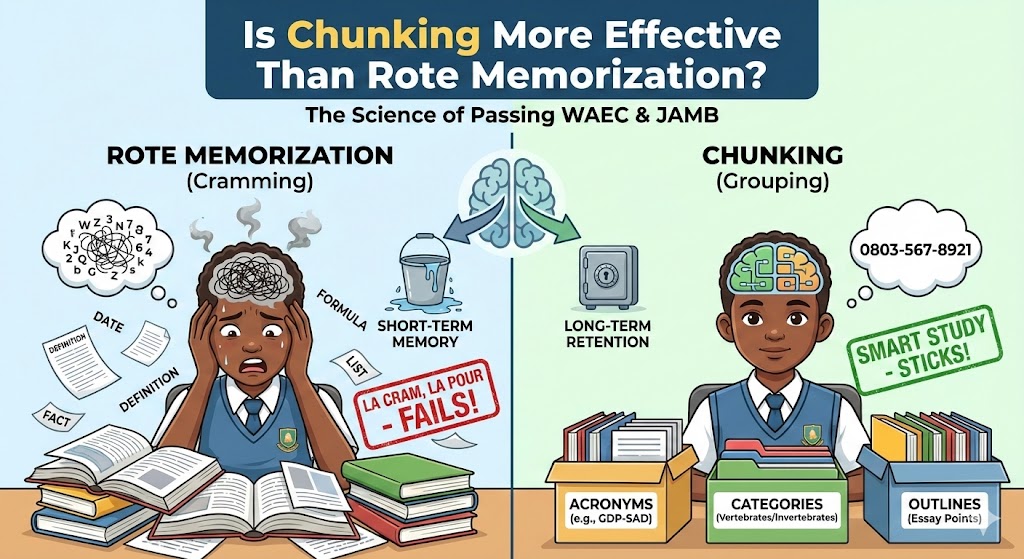
We are all guilty of the “fire brigade approach”—trying to cram the entire syllabus 48 hours before the exam.
The problem is that your brain acts like a sieve. According to the Forgetting Curve, you will forget about 50-80% of what you learned today by tomorrow if you don’t review it.
Since you aren’t taking notes to review later, you must re-read effectively.
-
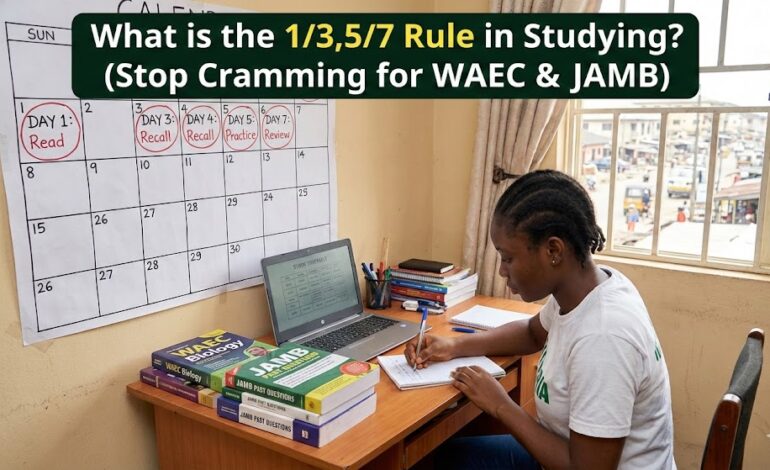
Day 1: Read the topic and use Active Recall.
-
Day 3: Quickly scan the headers and see if you can still explain the concepts.
-
Day 7: Do one more mental check.
This spacing signals to your brain that this information is important and shouldn’t be deleted. You can read more about how memory works and the science of Spaced Repetition here at the University of Waterloo’s guide.
5. Engage with the Text (Talk Back to the Book)
Treat your textbook like a conversation, not a monologue. When the author makes a point, pause and think, “Okay, but why is that true?” or “Ah, this connects to that topic we did last term.”
If you are reading a PDF or a photocopy, highlight only the keywords. Not the whole sentence. Just the trigger words that will jog your memory.
Is Note-Taking Ever Necessary?
Let’s be realistic. I’m not saying you should burn all your notebooks. There are times when writing is non-negotiable.
If you are studying Mathematics, Physics, or Chemistry, you must solve problems on paper. You cannot learn calculation by just looking at it. Also, for subjects like History or Government, specific dates and names can be slippery.
But for general understanding? You can trust your brain more than you think.
Summary
You don’t need to have the neatest notes to be the best student. You need the sharpest understanding.
By swapping hours of mindless writing for focused, active thinking, you save time and actually understand the material. Whether you are preparing for Post-UTME or a final year course, try leaving the pen alone for a few sessions. You might surprise yourself.
For more tips on preparing for major exams, you can check out the official resources on the JAMB website to stay updated on syllabus requirements.
What about you? Do you feel like you can’t study without a pen in your hand, or are you willing to try the “no notes” challenge? Let me know in the comments!




2 Comments
[…] Read the notes. […]
[…] happen to a student. Whether you are preparing for WAEC, JAMB, or your university semester exams, reading without remembering is a waste of precious time. You might as well be […]