


Group Study vs. Self Study: What Is A Better Method For Passing Your Exams?
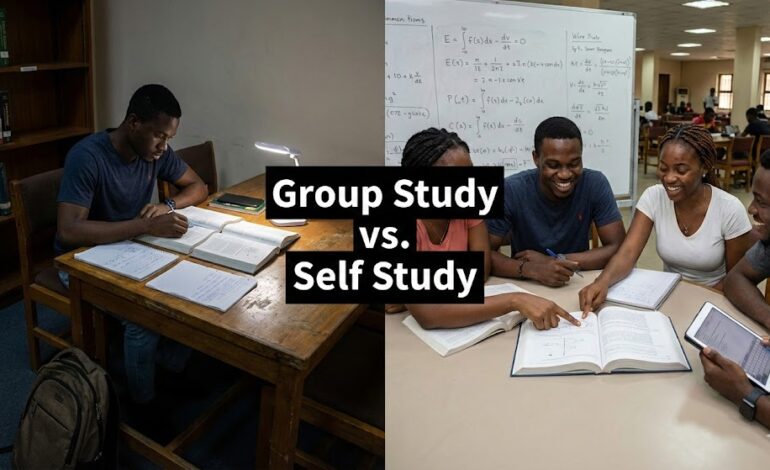
The exam timetable is out, and the pressure is mounting. Whether you are preparing for WAEC, JAMB, or your final university semester exams, the tension is real.
You grab your books and head to the library or the “night class” venue. But then you hit a dilemma. Should you find a quiet corner to battle the textbooks alone? Or should you join those guys arguing over a past question paper in the corner?
This is the question almost every Nigerian student asks at some point: what is a better method, group study or self study?
I’ve seen students fail while reading alone because they slept off, and I’ve seen others fail in groups because they spent all night discussing football and campus gist. So, which one actually works?
Let’s be honest with ourselves and break it down so you can choose the one that guarantees that ‘A’.

The Case for Self Study (The “Lone Wolf” Approach)
Self-study is the classic method. It’s just you, your handouts, and your focus. For many students, this is the default mode.
Why it works:
-
Zero Distractions: When you read alone, you don’t have to listen to Tunde explaining why he thinks the lecturer hates him. You control the environment.
-
Your Own Pace: You know your weak points. If you need to spend two hours understanding a single Chemistry formula, nobody is rushing you. If you are fast, you don’t have to wait for slow learners to catch up.
-
Deep Focus: Complex topics often require silence. You can’t solve serious calculation problems when people are chattering around you.
The Trap: It can get boring fast. Without discipline, “self-study” quickly turns into “scrolling through TikTok/Instagram” for two hours. Also, if you get stuck on a difficult topic, there is no one to ask. You might end up staring at the same page for an hour, frustrated.
According to research on learning retention, passively reading alone can sometimes lead to lower recall compared to active discussion. You can read more about active learning strategies here.
The Case for Group Study (The “Iron Sharpen Iron” Approach)
We’ve all seen those reading groups in the hostel or school area. When done right, this method is powerful.
Why it works:
-
Gap Filling: You might have missed a class or didn’t understand what the teacher said. In a group, a friend can explain it to you in “student language,” which is often easier to understand than the textbook.
-
Motivation: When you see your mates grinding hard, you feel challenged to sit up. It’s hard to sleep when everyone else is awake reading.
-
The Power of Teaching: The best way to prove you know something is to teach it. When you explain a point to your study group, it sticks in your brain forever.
The Trap: The “Gist” Factor. This is the biggest enemy of group study in Nigeria. You gather to read Physics, but 15 minutes later, you are discussing the latest music album or debating who is the richest musician. Before you know it, morning has broken, and you haven’t read anything.
So, What Is A Better Method, Group Study or Self Study?
Here is the truth: There is no single winner. The “better” method depends entirely on what you are studying and who you are.
If you are trying to memorize facts (like dates in Government or definitions in Biology), self-study is usually better. You need quiet time to let the information sink in.
However, if you are tackling problem-solving subjects (like Mathematics or Accounting) or trying to understand a complex concept, a group is often superior. Someone else might see the solution from an angle you missed.
My Advice? Use the “Hybrid” Method.
Don’t pick one and stick to it blindly. Mix them up for the best results.
-
Read Alone First: Never go to a group study empty-headed. Do your self-study first. Go through the material so you know exactly what you find difficult.
-
Meet to Discuss Problems: Use the group session specifically to tackle the hard questions you couldn’t solve alone.
-
Go Back to Solitude: After the group discussion, go back to your corner and review what you just learned to make sure it sticks.
It’s also vital to ensure your study environment is actually conducive to learning, regardless of the method you choose. This guide by the University of the People offers great tips on creating a study space.
How to Make Group Study Actually Work
If you decide that what is a better method, group study or self study, leans towards “group” for you, you must set rules. Otherwise, you are just wasting time.
-
Keep the Circle Small: 3 to 4 people is perfect. Anything more than that is a market, not a study group.
-
Pick Serious People: Avoid the “I don’t care” gang (remember them?). rolling with people who are serious about their grades will force you to be serious too.
-
Set a Goal: Before you open a book, agree on what you want to achieve. “Tonight, we must finish Organic Chemistry Chapter 1.” If you don’t have a goal, you will drift into conversation.
Conclusion
At the end of the day, passing WAEC, NECO, or your semester exams is about being honest with yourself.
If you know you love to talk, maybe avoid the group study until you have done some serious reading alone. If you know you sleep off easily, find a serious study partner to keep you awake.
What is a better method, group study or self study? The one that helps you write the correct answers in the exam hall.
Which team do you belong to? Team Solo or Team Group? Let me know in the comments section!






2 Comments
[…] you are tired of putting in maximum effort for average results, this is for you. Here are 7 secret study tips for competitive exams that most high-flyers won’t tell you […]
[…] and learning how to think, teachers are forced to rush. They have to drill students on how to pass the exam. The goal is no longer education; the goal is passing the […]