Is Chunking More Effective Than Rote Memorization?
Is Chunking More Effective Than Rote Memorization?
Ever feel like your brain is a leaking bucket?
You spend five hours reading your Government textbook. You repeat the dates over and over. You feel confident. But the moment you step into the exam hall and see the question paper, gbam—it’s gone. Blank space.
This is the struggle for almost every Nigerian student preparing for WAEC or JAMB. We are often taught that the harder we “jack” (study), the better. But hard work doesn’t always mean smart work.
If you are tired of forgetting what you read the next morning, you might be asking: Is chunking more effective than rote memorization?
The short answer? Yes. But let me be honest with you—it requires you to change how you study, and change is hard.
Let’s break down why “la cram, la pour” is failing you and how this “chunking” method can actually help you secure that admission.
The “La Cram, La Pour” Problem (Rote Memorization)
We all know this method. It’s the classic Nigerian style of learning.
You look at a definition. You repeat it twenty times. You close your eyes and say it again. You pray it sticks.
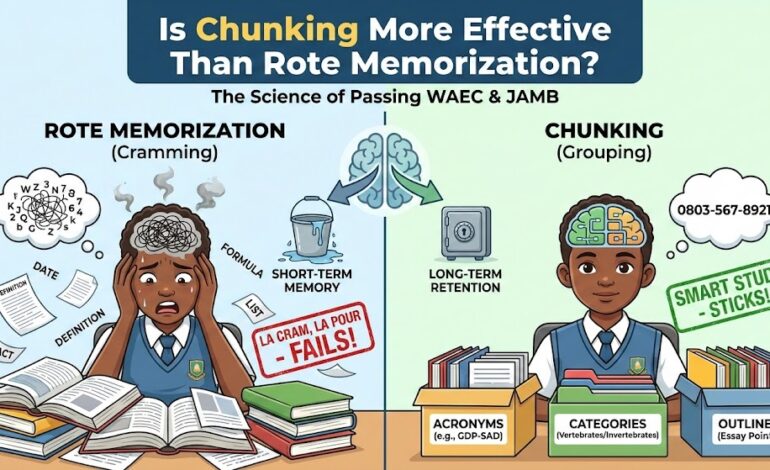
Rote memorization is basically trying to force information into your brain through repetition. It’s like trying to fetch water with a basket; you might catch a little bit, but most of it will drain away before you get home.
Why it fails you in the exam hall:
-
It’s shallow: You aren’t understanding the topic; you are just memorizing the arrangement of words.
-
Stress kills it: When you are under pressure (like when the invigilator yells “Five minutes remaining!”), your brain panics. Rote memory is the first thing to disappear when you are stressed.
-
No connections: If you forget one word in the sentence, you usually lose the whole definition.
As I mentioned in my article on [7 Student Habits That Lead to Exam Failure and How to Avoid Them], relying solely on cramming is a hallmark of the “Cram and Pour” student. It works for a class test sometimes, but for a massive syllabus like JAMB? It’s a trap.
What is Chunking? (The “Phone Number” Trick)
Imagine I tell you to memorize this number: 08035678921.
If you try to remember “Zero, eight, zero, three, five, six…” individually, you will struggle.
But what do you naturally do? You break it down: 0803 – 567 – 8921.
That is chunking. It is the process of breaking big, scary pieces of information into smaller, meaningful groups. Your brain loves patterns. It hates clutter.
When you ask, is chunking more effective than rote memorization? you are asking if organization is better than chaos.
According to cognitive psychology, our short-term memory can only hold about 4 to 7 “items” at a time. If you try to shove 20 disparate facts in there, 13 of them will fall out. But if you group those 20 facts into 4 “chunks,” they fit perfectly.
How to Actually Use Chunking for WAEC and JAMB
Okay, enough theory. How do you actually use this when you are staring at a Physics textbook or a list of Literature quotes?
Here are three practical ways I’ve used this method.
1. Acronyms and Mnemonics
This is the most common form of chunking. Instead of remembering 9 different planets, you remember “My Very Eyes May Just See Under Nine Planets” (Wait, is Pluto still a planet? You get the point).
For my Economics students, remembering the characteristics of money? Don’t just memorize the list. Chunk it into a word like GDP-SAD (General acceptability, Divisibility, Portability, etc.).
2. Categorize Your Study Material
Let’s say you are studying Biology—specifically the Classification of Living Things.
Don’t just read the list of animals from top to bottom.
Do create groups.
-
Chunk 1: Animals with backbones (Vertebrates).
-
Chunk 2: Animals without backbones (Invertebrates).
By grouping them, your brain creates a “folder” for each category. It’s easier to find a file in a folder than a file thrown randomly on your desktop.
3. The “Outline” Method for Essay Writing
If you are an Arts student writing Government or Literature essays, don’t try to memorize a whole essay.
Chunk the essay into points:
-
Introduction (The Hook).
-
Point 1 (The definition).
-
Point 2 (The cause).
-
Point 3 (The effect).
-
Conclusion.
Memorize the headers, not the full paragraphs. Your brain will fill in the rest during the exam.
Is Chunking Always Better?
I want to be real with you. I’m not going to sit here and tell you that you never need to memorize anything ever again.
There are times when rote memorization is necessary.
-
Multiplication tables: You just need to know that 7 x 7 is 49.
-
Formulas: sometimes you just have to cram the quadratic formula until it sticks.
-
Vocabulary: Learning a new language often starts with rote repetition.
However, for 90% of your secondary school work—where you need to understand concepts to answer “theory” questions—chunking wins hands down.
Research from reputable sources like [VeryWellMind on Cognitive Psychology] supports this, showing that organizing information significantly boosts long-term retention compared to isolated repetition.
Summary: The Battle of the Brain
| Feature | Rote Memorization (Cramming) | Chunking (Grouping) |
| Effort Level | Low (at first), High (during recall) | High (initial setup), Low (during recall) |
| Retention | Short-term (Days) | Long-term (Months/Years) |
| Exam Stress | Fails under pressure | Resilient under pressure |
| Best For | Simple lists, formulas | Complex concepts, history, essays |
The Final Verdict
So, is chunking more effective than rote memorization?
If your goal is to pass a quiz tomorrow morning? Maybe rote memorization will save you. But if your goal is to crush WAEC, score 300+ in JAMB, and actually survive in the University, you need to start chunking.
Stop feeding your brain raw data. Cook it first. Organize it.
Next Step:
Tonight, pick one difficult topic you’ve been struggling to memorize. Don’t read it over and over. Take a piece of paper, look for patterns, and break it into 3 distinct groups. Try it once, and see how much better you remember it tomorrow.
You’ve got this.