Debate: Violent Video Games Should Be Banned (6 Powerful Points)
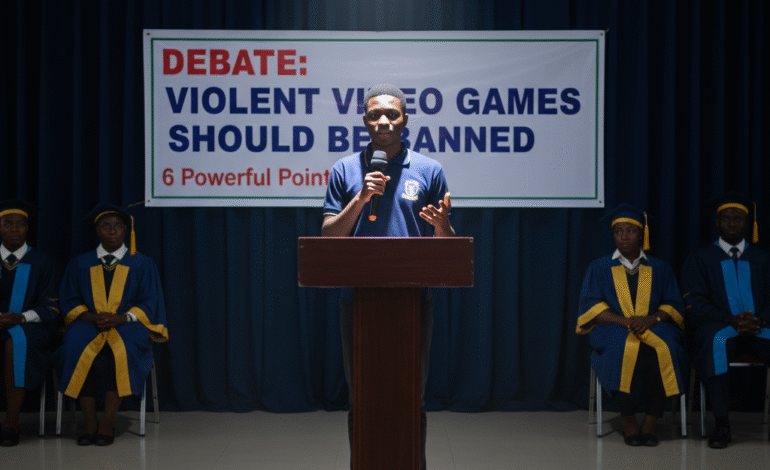
Debate: Violent Video Games Should Be Banned (6 Powerful Points)
Good day, students!
Are you arguing for the motion that violent video games must be banned? If you’re looking for the arguments that will win you the points, you’ve come to the right place.
I’m here to provide the winning violent video games should be banned debate points you need to convince the judges.
First, let’s define our terms. “Violent video games” are not just any game; they are games where the main goal is to use extreme violence, like killing, maiming, or torturing, to win. “Banned” means they should be made illegal to sell and distribute, especially to young people.
Disclaimer: This article is a script for one side of an educational debate. We know many people play games without issues, but our job today is to focus on the serious dangers to win this motion.
Winning Debate Points on Why Violent Video Games Should Be Banned
Good day, Mr. Chairman, panel of judges, accurate time-keeper, co-debaters, and all protocols observed. I am here today to stand firmly for the motion that violent video games must be banned.
1. They Directly Increase Aggressive Behavior
My first point is direct. These games are not “just games.” They are training simulators for aggression.
When a student spends hours practicing violence, even on a screen, it doesn’t just stay in the game. That feeling, that aggressive behavior, bleeds into the real world. They become more impatient, quicker to anger, and more likely to solve their problems with their fists instead of their words. It’s a clear negative impact on youth.
2. They Cause Desensitization to Violence
Now, let’s talk about the psychological effects. What happens when you see something terrible—like blood, death, and cruelty—over and over again? You stop feeling. It becomes normal.
This is called desensitization to violence. When a child sees killing as a “point” in a game, they start to lose empathy. They lose that human feeling that tells them violence is wrong and painful. This is a serious danger to our society.
3. They Blur the Line Between Reality and Fantasy
Another key point is how these games affect a young, developing mind. They are so realistic now! The graphics, the sound… it’s overwhelming.
This intense exposure makes it hard to separate the game world from the real world. This is called blurring reality. Young people might start to think that consequences in real life are like in a game, where you just “respawn” or restart. This leads to poor impulse control and very dangerous real-world decisions.
4. There is a Clear Link to Real-World Violence
My opponents will say there is “no proof.” This is simply not true.
While not every person who plays a game becomes a criminal, many tragic events and school shootings have been linked to these games. We see cases of copycat behavior, where young people act out the exact violent scenes they practiced for hours in a game. Even if this link to real-world violence only affects a small number of people, isn’t one human life lost too many?
5. They Expose Youth to Harmful Content
We have laws in this country to protect children from harmful content. We don’t let young students watch certain movies or buy certain magazines.
So why, my co-debaters, do we allow them to participate in the most extreme forms of violence imaginable? Banning these games is not about “censorship”; it’s about protection. It’s about being consistent. We must protect our youth from this negative and corrupting influence.
6. They Contribute to Mental Health Issues
Finally, let’s look at the mental health issues. This constant exposure to digital violence, stress, and aggression is not healthy.
It is proven to increase anxiety, depression, and social isolation. Instead of learning, interacting with family, or playing outside, children are locked in these dark, violent, and addictive worlds for hours on end. It’s a curse on their mental well-being.
Frequently Asked Questions (FAQs)
But what about “freedom of speech” or “art”? Freedom of speech has limits. You can’t shout “Fire!” in a crowded hall. In the same way, that freedom does not mean you have the freedom to harm society. These games are a danger to public health, especially the mental health of our youth. Protecting children is more important than a company’s “artistic right” to sell murder simulators.
Isn’t it the parents’ job to control this? Yes, parents have a role, but the government also has a role to protect its citizens. The rating systems are clearly not working. Children can easily get these games from friends or the internet. When a product is this dangerous and this addictive, “parental control” is not enough. A full ban is the only way to truly solve the problem.
How do I conclude this debate? You summarize your main points. Remind the judges of the desensitization, the aggressive behavior, and the blurring of reality. End by saying that for the safety of our generation and the preservation of our empathy, we have no choice but to ban these harmful products.
Conclusion / Summary
So, we have seen that violent video games are not just harmless fun. They increase aggressive behavior, they cause desensitization to violence, and they have a clear negative impact on youth.
These violent video games should be banned debate points show that this is a serious public safety issue that we can no longer ignore.
Final Disclaimer: Remember, this is an educational debate. This article is a script to help you argue the pro-ban side. The goal is to practice public speaking and understand all sides of an issue.
What do you think? Drop your opinions in the comments section below… Also, feel free to share this post with your coursemates or those in your debate team!