Debate: Vocational Education is Better Than Formal Education (7 Winning Points)
Debate: Vocational Education is Better Than Formal Education (7 Winning Points)
Good day, students!
Looking for the winning points for your next debate? You’ve come to the right place. We’re going to tackle a very important topic: the debate on vocational education is better than formal education. This template is for you if you are supporting this motion and need the script to win.
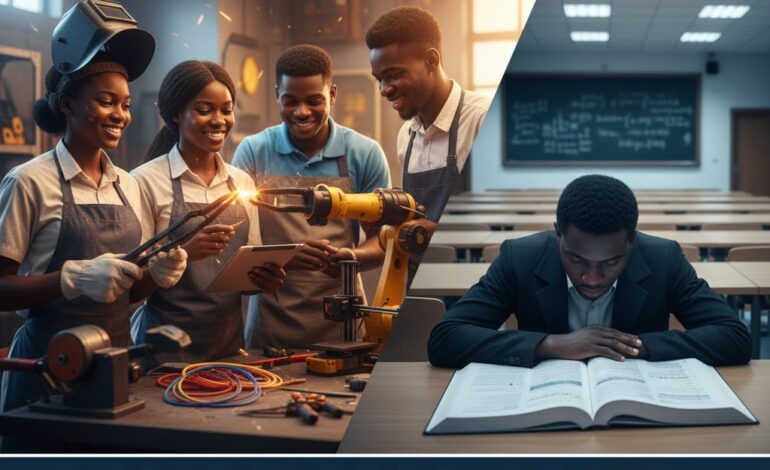
So, what are we talking about? Formal education is the ‘traditional’ school system you know—primary, secondary, and university—that focuses on academics and degrees. Vocational education (or VTE) is different. It focuses on training you for a specific job or practical skill, like carpentry, coding, fashion design, or catering.
Now, a quick note: This article is to help you win your school debate. We are not saying that formal education is useless! Both are important. But for this debate, our job is to prove why vocational training has the upper hand.

Winning Debate Points on Why Vocational Education is Better
Here is the “script” you can adapt. Deliver these points with confidence.
1. It Leads Directly to Employment
Good day, Mr. Chairman, panel of judges, co-debaters, and my fellow students. My first and most important point is that vocational education leads directly to employment.
Think about it. While a university student spends four or five years studying theory, a vocational student spends one or two years learning a practical skill that the job market needs right now.
A mechanic doesn’t need a B.Sc. in Physics to fix a car. A coder doesn’t need a degree in History to build a website. They need the skill. Vocational education gives them that skill, making their employability almost immediate. The skills gap in Nigeria is not for theorists; it’s for people who can do.
2. It Creates Job Creators, Not Job Seekers
My second point is a big one: vocational education is the key to fighting unemployment.
Traditional education often trains people to look for white-collar jobs. It prepares you to write a CV and wait to be employed. But what happens when there are no jobs?
Vocational education is different. It trains you for self-employment. It gives you the power of entrepreneurship. A trained fashion designer, a baker, or a plumber doesn’t need to wait for a government job. They can open their own shop, hire others, and become an employer themselves. This is exactly what our economy needs.
3. It is Built on Practical, Hands-on Training
Let’s be honest. How much of the complex theory learned in traditional education do we use every day?
Vocational education is 100% practical. It’s all hands-on training. You learn by doing. This method is not only more engaging, but it also means the student truly masters the skill. When you graduate, you are not just “book-smart”; you are “work-ready.” This practical experience is what employers are desperate for.
4. It is More Accessible, Cheaper, and Faster
Another key point is cost and time. How many talented Nigerians cannot afford to go to university? It’s expensive and takes many years, especially with strikes.
Vocational training is often much cheaper and much shorter. In six months or a year, you can gain a skill that feeds you for life. This makes it a more realistic and democratic path to success for the average person. It breaks the idea that you must be rich to become successful.
5. It Reduces Crime and Social Vices
“An idle mind is the devil’s workshop.” When thousands of young people graduate with degrees but no jobs, what happens? They become frustrated. This frustration can lead to crime and other social vices.
Now, imagine this: Skill acquisition centres are everywhere. Young people are busy learning tailoring, POP installation, and solar panel repair. They are earning money. They have a purpose. Vocational education gives them a productive alternative, building a safer and better society for all of us.
6. It Doesn’t Discriminate Based on ‘Book Smart’
The truth is, not everyone is designed for purely academic, traditional education. Some people are brilliant with their hands.
Formal education often labels these people as “failures” just because they are not good at exams. Vocational education says, “You are not a failure. You are a practical genius.” It gives everyone a chance to succeed, whether you are a ‘book-smart’ or ‘hand-smart’ person. This is why the debate on vocational education is better than formal education leans in our favour—it’s more inclusive.
7. It Builds the Real, Tangible Economy
My final point. What builds a nation? Is it theories, or is it action?
We need people who can build our houses, fix our cars, sew our clothes, and install our electricity. These are the skills that make a country work. Vocational education provides the skilled workforce that builds the real, tangible economy from the ground up. Without these skills, the entire system collapses.
Frequently Asked Questions (FAQs)
What is the strongest argument for the other side (formal education)?
The strongest argument for the opposition is that formal education provides a broader foundation of knowledge and critical thinking. They will say it’s necessary for creating doctors, lawyers, and engineers who need deep theoretical knowledge. Your job is to agree this is true, but argue that for the majority of people and the immediate needs of our economy, vocational skills are better and more urgent.
How do I conclude this debate speech?
A strong conclusion restates your main theme. Don’t just list your points again. End with a powerful statement like: “Mr. Chairman, the opposition believes in waiting for jobs. We, on this side, believe in creating them. Vocational education is not just an alternative path; it is the priority path to a productive, employed, and self-reliant nation. Thank you.”
Is this debate saying university is useless?
No, not at all. This is a common trap. Don’t fall for it. The topic is ‘better than,’ not ‘instead of.’ We are simply arguing that in our current economic climate, the immediate, practical, and entrepreneurial benefits of vocational skills provide more value to the individual and society than the longer, more theoretical path of formal education.
Conclusion / Summary
To wrap it up, these points show a clear argument. The debate on vocational education is better than formal education is won by focusing on practical skills, immediate employability, and the power of entrepreneurship. It’s about creating job creators, not just job seekers.
Final Disclaimer: Remember, this is a debate! In the real world, both formal and vocational education are critical. Nigeria needs its doctors and its plumbers. This template is simply a tool to help you argue one side for your educational activity.
What do you think? Do you have another winning point? Drop your opinions in the comments section below! Also, feel free to share this post with your coursemates or those in your debate team!