9 Memorization Tips for Studying: How to Remember What You Read for Your Exams
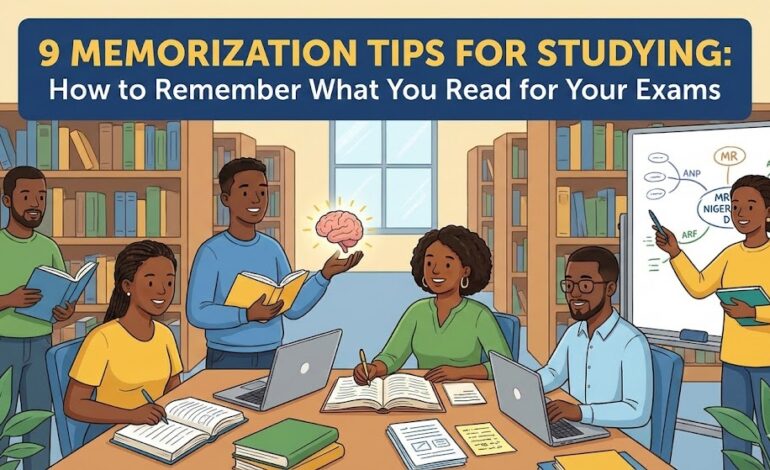
9 Memorization Tips for Studying: How to Remember What You Read for Your Exams
Ever had that sinking feeling in an exam hall?
You know the feeling I’m talking about. You stare at Question 3. You know you read this topic. In fact, you remember exactly where it is in your notebook. You remember the color of the pen you used. But the answer? It’s completely gone.
Blank.
It is one of the most frustrating things that can happen to a student. Whether you are preparing for WAEC, JAMB, or your university semester exams, reading without remembering is a waste of precious time. You might as well be sleeping.
The problem usually isn’t that your brain is “bad” or that you aren’t brilliant. The problem is your method.
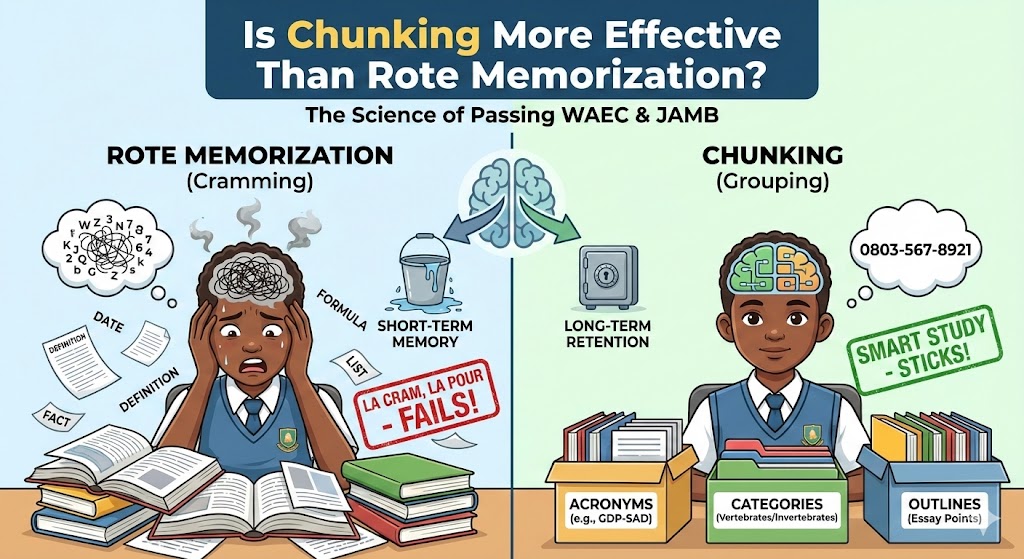
Most students rely on “cramming and pouring.” It might work for a quick test, but for a major exam covering 15 topics? That’s a recipe for disaster. If you are tired of blanking out when it matters most, you need to change how you study.
Here are 9 memorization tips for studying: how to remember what you read for your exams, broken down practically.
1. The “Teacher” Method (Feynman Technique)
This is my absolute favorite because it exposes you instantly.
Here is the logic: If you can’t explain a topic simply, you don’t understand it. You only think you do.
After reading a complex topic—let’s say, Federalism in Government or Electrolysis in Chemistry—close the textbook. Look at your empty wall or your mirror and try to teach that topic to an imaginary class of JSS1 students.
Can you explain it without using big grammar? Can you break it down?
If you find yourself stuttering or checking the book every 5 seconds, you haven’t mastered it yet. Go back and read it again. When you can teach it, you have memorized it.
2. Use Acronyms and Mnemonics
If you went to a Nigerian secondary school, you definitely know “MR NIGER D.”
That simple acronym helped millions of us remember the characteristics of living things (Movement, Respiration, Nutrition, etc.) without stress. Why stop there? Create your own.
If you have a list of points to memorize for a History essay or Economics theory, take the first letter of each point and form a funny word or sentence.
The crazier the sentence, the easier it is to remember. Your brain loves weird things. If you need to remember the order of planets, a funny sentence about “My Very Eyes…” sticks faster than rote memorization.
3. Stop the “Fire Brigade” Approach (Spaced Repetition)
I see this every exam season. Students wait until the timetable is out before they open their books. Then, they try to shove three months of work into three nights.
That is spiritual suicide.
Your brain is like a muscle. You cannot go to the gym once and lift 100kg. You build up to it.
This is where Spaced Repetition comes in. Instead of reading a topic for 5 hours once, read it for 30 minutes today, review it for 10 minutes two days later, and glance at it again next week.
By spacing out your revision, you force your brain to recall the information just as it is about to forget it. This moves the information from your short-term memory (which fails easily) to your long-term memory.
4. Active Recall (Close the Book!)
This is where many students deceive themselves.
You read a page. You nod your head. You say, “Yes, I get it.” Then you move to the next page.
That is passive reading. It feels easy, but it’s weak.
To truly remember, you need Active Recall. After reading a section, close the book. Look away. Ask yourself: “What did I just read?” Force your brain to dig up the answer without looking.
It will feel uncomfortable. You might struggle. That struggle is good! That is the feeling of your brain actually building the connection.
5. Understand, Don’t Just Memorize
Have you ever tried to memorize a song in a language you don’t speak? It’s hard. But memorizing the lyrics to a song you love is easy.
Why? Because you understand the flow.
Before you try to cram a definition, try to understand the concept. If you are reading about Demand and Supply in Economics, don’t just memorize the law. Ask yourself: “How does this apply to the price of garri in the market?”
When you connect the book theory to real-life reality, you don’t need to struggle to remember it. It just makes sense.
6. Use Past Questions Strategically
You cannot prepare for a Nigerian exam without past questions. It’s like going to war without a map.
But don’t just memorize the answers to the past questions (JAMB sometimes changes the options!). Use past questions to test your memory.
Pick a year—say, 2018—and treat it like a real exam. Time yourself. No checking textbooks.
This does two things:
-
It shows you exactly what you have forgotten.
-
It helps you get used to the way JAMB or WAEC phrase their questions.
7. Sleep (You Can’t Cheat Nature)
I know the “Till Day Break” (TDB) culture is strong in university. We feel like heroes when we read all night.
But let me be honest with you: consistently depriving yourself of sleep is a waste of time.
Sleep is when your brain hits the “Save” button. If you study for 8 hours and then don’t sleep, a lot of that information disappears. Research consistently shows that students who sleep well perform better than those who pull all-nighters.
If you must do TDB, make sure you sleep well the next day. A tired brain is a leaky bucket.
8. Mix Up Your Environment
Sometimes, your brain gets bored.
If you always study at the same desk in your room, your brain goes on autopilot. Try changing it up. Go to the school library. Find a quiet spot under a tree.
Changing your location can create new mental associations that help you recall information later.
9. Use Visualization and Stories
Humans are visual creatures. We remember pictures better than text.
If you are trying to remember a historical event or a biological process, turn it into a movie in your head. Visualize the blood cells fighting the virus. Visualize the pre-colonial trade routes like a map in your mind.
The more vivid the image, the harder it is to forget.
Conclusion
Passing exams isn’t just about how many hours you spend holding a book. It’s about how many of those hours actually stick.
You don’t have to use all 9 memorization tips for studying at once. Pick two or three that sound interesting to you—maybe the “Teacher Method” and “Active Recall”—and try them out for your next test.
You might be surprised at how much easier it is to score that A.
Which of these tips have you tried before? Or do you have a special “secret format” for remembering things? Tell me in the comments below!