


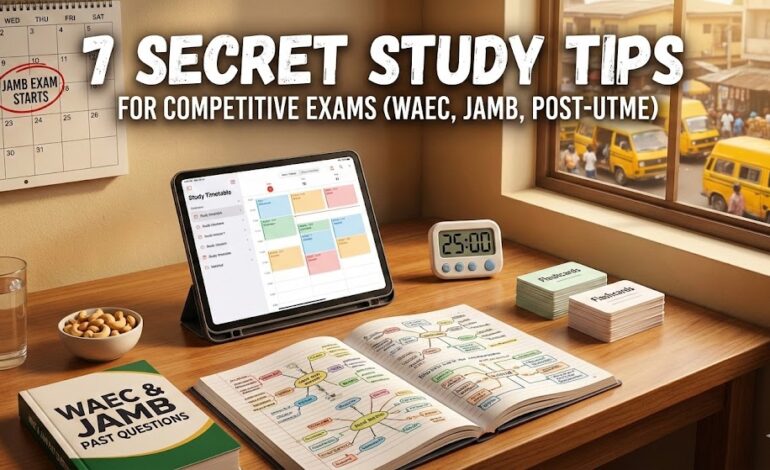
7 Secret Study Tips for Competitive Exams (Stop Cramming, Start Passing)
Let’s be honest for a second. We all know that one student who reads 24/7, “burns the midnight candle” until their eyes turn red, yet still struggles to hit the cut-off mark.
It’s frustrating.
You buy the textbooks. You attend the tutorial centers. You deprive yourself of sleep. But when the results come out, the grades don’t match the effort. Why?
Because in competitive exams like JAMB, WAEC, or Post-UTME, hard work isn’t enough. You need smart work.
Most students are just reading; they aren’t actually studying. There is a massive difference. Over the years, I’ve realized that top scorers aren’t necessarily the smartest people in the room—they just have better strategies.
If you are tired of putting in maximum effort for average results, this is for you. Here are 7 secret study tips for competitive exams that most high-flyers won’t tell you about.

1. The “Blurting” Method (Active Recall)
Most students study passively. You open your New School Physics, read a page, nod your head, and think, “Okay, I get it.”
But do you?
Passive reading is the biggest trap. Your brain recognizes the information, but it hasn’t actually stored it.
Here is a better way: Active Recall.
I call it the “Blurting Method.” Read a topic for 20 minutes. Then, close the book. Hide your notes. Take a blank sheet of paper and scribble down everything you can remember without looking.
It will be hard. You might only remember 30% of what you read. That is okay. The struggle to remember is actually where the learning happens. Open the book, check what you missed, and try again.
2. Use the Feynman Technique (Teach It)
Imagine you have to explain Stoichiometry or Government Systems to your 10-year-old sibling.
Could you do it?
If you can’t explain a concept simply, you don’t understand it well enough. This is the core of the Feynman Technique. Albert Einstein once said, “If you can’t explain it simply, you don’t understand it well enough.”
Don’t just memorize definitions to “pour” them back onto the exam paper.
Stand in front of your mirror. Pretend you are the lecturer. Teach the topic to an imaginary class. When you get stuck or start using big, confusing words to cover up gaps in your knowledge, that’s a sign you need to go back to the textbook.
3. Treat Past Questions Like Gold
I cannot stress this enough. If you are preparing for JAMB or WAEC and you aren’t obsessed with past questions, you are playing with fire.
Exam bodies in Nigeria are notorious for repeating questions. Sometimes they change the values, but the pattern remains the same.
But here is the mistake most people make: They use past questions to test themselves.
Instead, use past questions to learn. Don’t just check if the answer is A, B, C, or D. Find out why the answer is A. Why are B, C, and D wrong?
Understanding the “why” is what saves you when they twist the question in the real exam.
Recommended: [5 Types of students who will PASS their next exams]
4. Spaced Repetition (Beat the Forgetting Curve)
Ever heard of the “Forgetting Curve”?
It’s a fancy way of saying that if you learn something today, you will forget about 50% of it by tomorrow and 90% within a week unless you review it.
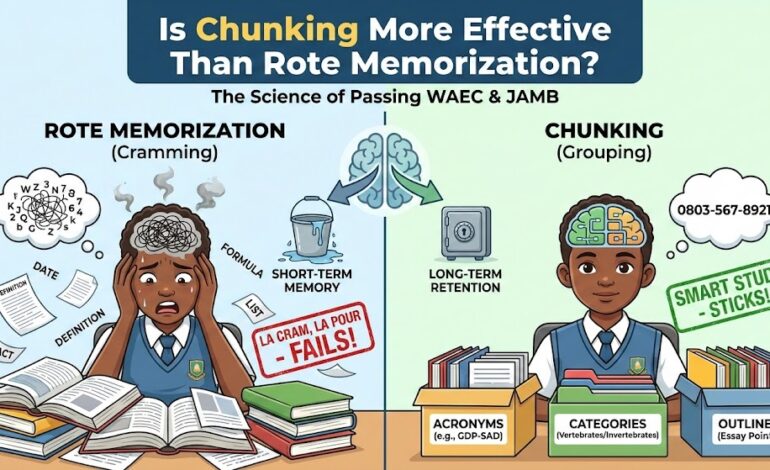
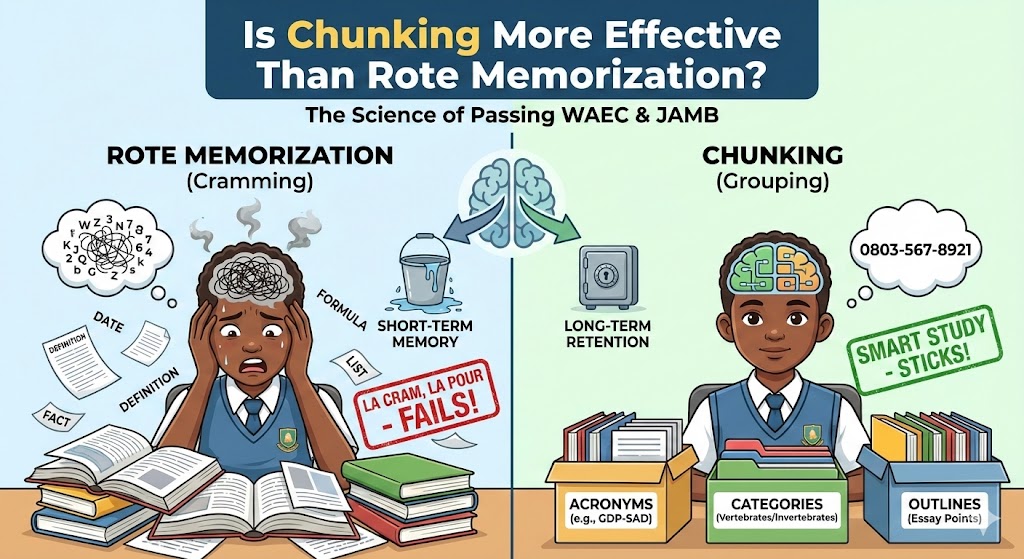
This is why “la cram, la pour” fails. You cram everything the night before, dump it in the exam hall, and forget it immediately. That might work for a class test, but for a competitive exam covering 3 years of work? It’s a suicide mission.
Space out your reviews.
-
Read a topic today.
-
Review it tomorrow (10 minutes).
-
Review it again in 3 days.
-
Review it again in a week.
This forces the information into your long-term memory.
5. Simulate Exam Conditions
The exam hall is a different beast. It’s quiet, tense, and the clock is ticking.
Many students fail not because they don’t know the answers, but because they panic under pressure. They run out of time.
Don’t let the exam day be the first time you sit for 2 hours straight to solve questions.
Every weekend, set a timer. Put your phone away. Sit at a table (not on your bed!) and take a full-length mock exam. If the exam is 2 hours, stop exactly at 2 hours.
This builds your stamina. It teaches you which questions to skip and which to attack first. By the time the real JAMB or Post-UTME comes, it will just feel like another practice session.
6. The Pomodoro Technique (Manage Your Focus)
You might think you need to study for 8 hours straight to pass.
Let me be honest: that’s a quick way to burn out.
The human brain isn’t designed to focus intensely for that long. After about 45 minutes, your concentration drops, and you’re just staring at words without processing them.
Try the Pomodoro Technique:
-
Pick a task (e.g., Read Chapter 3 of Biology).
-
Set a timer for 25 or 30 minutes.
-
Focus purely on study. No WhatsApp, no TikTok.
-
When the timer rings, take a 5-minute break. Walk around, drink water.
-
Repeat.
This keeps your brain fresh and stops that “heavy head” feeling.
Recommended: [How to prepare for JAMB without stress]
7. Fix Your Physical Engine
You are not a robot.
I see so many students surviving on soft drinks, gala, and 3 hours of sleep during exam season. They wear it like a badge of honor.
“I didn’t sleep all night!”
That’s not a flex. It’s actually hurting your grades. Your brain consolidates memory while you sleep. If you don’t sleep, all that reading you did doesn’t get “saved” to your hard drive.
According to research from the Sleep Foundation, teenagers and young adults need significant rest for cognitive function. Depriving yourself of sleep reduces your ability to solve logical problems—the exact thing you need for subjects like Maths and Physics.
Eat real food. Drink water. Sleep at least 6-7 hours. A healthy brain recalls facts faster than a tired one.
Conclusion
Passing competitive exams isn’t magic. It’s not about who has the biggest head or who talks the most in class.
It comes down to strategy.
If you apply these 7 secret study tips for competitive exams, you will notice a shift. You’ll stop feeling overwhelmed and start feeling in control.
Which of these methods have you tried before? Or do you have a unique study style that works for you? Let me know in the comments section below—I’d love to hear from you.




2 Comments
[…] We are all guilty of the “fire brigade approach”—trying to cram the entire syllabus 48 hours before the exam. […]
[…] have time to read everything, so you have to be smart about what you read. You need Last Minute Study Tips for Exams That Actually Works to save your […]